


Home › Software › Airtable › Alternatives
Last updated: October 29, 2026
TechCurato is reader-supported. Some links on this page are affiliate links: if you sign up through them, we may earn a commission at no extra cost to you. It never changes which tools we recommend or how we rank them. Learn more.
6 Best Airtable Alternatives in 2026 (Prices & Limits Compared)
Airtable is still one of the best spreadsheet-database hybrids around. But two things push teams to look elsewhere: record limits (1,000 records per base on the free plan, 50,000 on Team) and per-editor pricing that climbs fast as your team grows ($20 per editor per month on Team, $45 on Business, billed annually).
We compared six alternatives on what actually matters when you switch: price for a real team, record limits, automations, and whether you can self-host. Here is the short version.
Quick answer: the best Airtable alternatives
- monday.com — best for teams that use Airtable to manage projects and workflows. From $9 per seat per month.
- ClickUp — best all-in-one workspace on a budget. From $9 per user per month.
- SmartSuite — the closest thing to Airtable, with up to 100,000 records per solution.
- NocoDB — best for self-hosting and automation-heavy teams (n8n, Make).
- Baserow — best open-source option, with no row limits when self-hosted.
- Notion — best if your "database" is really docs, wikis and light tracking.
Airtable alternatives compared
All prices are per user (or per editor) per month, billed annually unless noted. Checked on each vendor's pricing page on October 29, 2026.
| Tool | Free plan | Entry paid plan | Records on entry plan | Self-hosting | Best for |
|---|---|---|---|---|---|
| Airtable (reference) | Yes — 1,000 records/base, 100 automation runs/month | Team: $20 ($24 monthly) | 50,000 per base | No | — |
| monday.com | Yes — up to 2 seats, 3 boards | Basic: $9 (3-seat minimum) | Unlimited items | No | Project & workflow management |
| ClickUp | Yes — 60 MB storage, 100 automation actions/month | Core: $9 | Not record-based | No | All-in-one on a budget |
| SmartSuite | No — 14-day trial | Team: $15 ($20 monthly), 3-user minimum | 5,000 per solution | No | Closest Airtable experience |
| NocoDB | Yes — 3 editors, 1,000 records | Plus: $12 ($15 monthly), or $108/month for unlimited seats | 50,000 | Yes — free Community edition | Self-hosting & automation |
| Baserow | Yes — 3,000 rows per workspace | Premium: $10 ($12 monthly) | 50,000 per workspace | Yes — open source | Open source, unlimited rows self-hosted |
| Notion | Yes — limited blocks for 2+ members | Plus: $10 (monthly price) | Not record-based | No | Docs + light databases |
What a 5-person team actually pays
Per-seat prices hide the real number. Here is the monthly cost for a team of five editors, billed annually:
- Airtable Team: $100/month (50,000 records per base)
- ClickUp Core: $45/month
- monday.com Basic: $45/month · Standard (with automations): $60/month
- Baserow Premium: $50/month (50,000 rows)
- NocoDB Plus: $60/month (50,000 records)
- SmartSuite Team: $75/month (only 5,000 records per solution — Professional at $160/month raises that to 100,000)
- NocoDB or Baserow self-hosted: $0 in licenses, plus your server (a small VPS typically costs $5–20/month)
Why people switch from Airtable
- Record limits. The free plan stops at 1,000 records per base. Team stops at 50,000 and Business at 125,000. When you hit the limit, your base still works but you can't add new records until you upgrade.
- Per-editor pricing. Everyone with edit rights on any base is billed. A 10-person team on Business pays $450 per month on annual billing.
- Automation caps. 100 automation runs per month on Free, 25,000 on Team. Teams that connect Airtable to n8n, Make or Zapier also run into the API limit (1,000 calls per month on Free).
- Permissions. One of the top Google results for this search is a Reddit thread from users looking for finer-grained permissions — a recurring complaint in the Airtable community.
- Data ownership. Airtable is cloud-only. Teams with compliance requirements, or who simply want to own their data, look at self-hosted options.
The 6 best Airtable alternatives in detail
1.  monday.com — best for project and workflow management
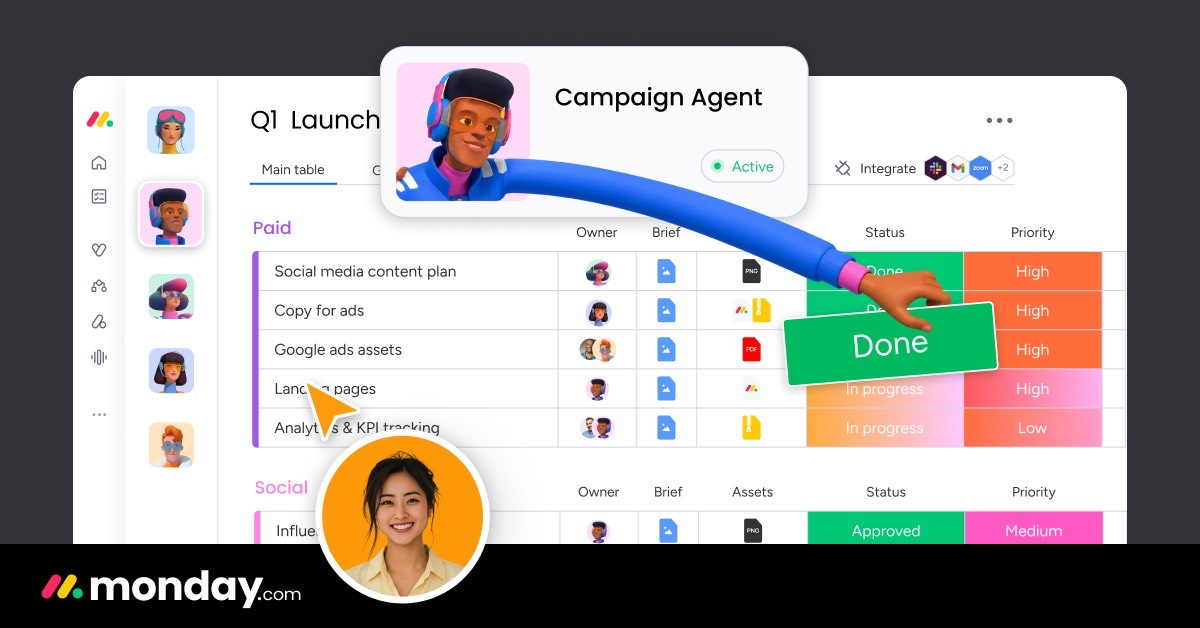
If you use Airtable mostly to track projects, content calendars, or client work, monday.com is the most natural upgrade. Boards look like Airtable tables, but come with stronger project features out of the box: timelines, workload views, dashboards and automations.
Pricing: free for up to 2 seats (3 boards). Paid plans start at $9 (Basic), $12 (Standard) and $19 (Pro) per seat per month, billed annually, with a 3-seat minimum. Standard includes 250 automation actions per month; Pro includes 25,000.
- Pros: unlimited items on paid plans; polished interface that non-technical teammates adopt quickly; dedicated CRM and dev products if you grow.
- Cons: 3-seat minimum makes it pricier for solo users; automations are limited on Standard; less flexible than Airtable for relational data.
Choose it if: your Airtable base is really a project tracker.
2.  ClickUp — best all-in-one workspace on a budget

ClickUp replaces several tools at once: tasks, docs, whiteboards, chat, goals and a table view with custom fields. It is not a true relational database like Airtable, but for most task and project use cases it covers the same ground for less money.
Pricing: Free Forever (60 MB storage, 100 automation actions per month). Core costs $9 and Business $17 per user per month, billed annually. Core includes 1,000 automations per month; Business includes 10,000.
- Pros: lowest entry price in this list; huge feature set; generous free plan for individuals.
- Cons: the number of features can overwhelm small teams; table view is less powerful than Airtable for linked records and formulas.
Choose it if: you want one tool for tasks, docs and lightweight databases, at the lowest cost.
3.  SmartSuite — the closest Airtable experience
SmartSuite is built on the same idea as Airtable — flexible tables with linked records — and adds project-management features on top. It is the easiest migration if you rely on relational data.
Pricing: no free plan, but a 14-day trial without a credit card. Team costs $15 per member per month billed annually ($20 monthly, 3-user minimum) with 5,000 records per solution. Professional costs $32 ($36 monthly, 5-user minimum) with 100,000 records per solution.
- Pros: closest feature match to Airtable; 100,000 records per solution on Professional; unlimited solutions on every plan.
- Cons: no free plan; the Team plan's 5,000-record limit is lower than Airtable Team's 50,000.
Choose it if: you want Airtable's model with more records, and you'll pay for Professional.
4.  NocoDB — best for self-hosting and automation
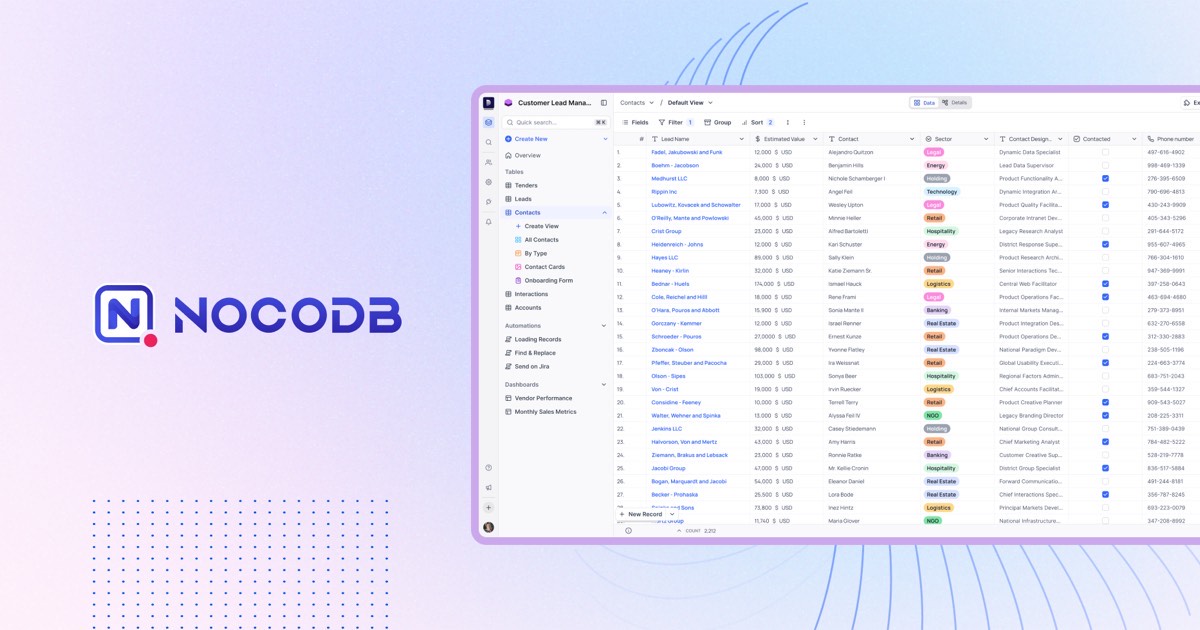
NocoDB turns a database into a spreadsheet-style interface. You can use its cloud version or run it yourself for free. It is popular with teams that automate heavily with n8n or Make, because the self-hosted edition has no record, storage or API caps.
Pricing: cloud Free supports 3 editors and 1,000 records. Plus costs $12 per seat per month billed annually ($15 monthly), or $108 per month for unlimited seats, with 50,000 records. Business costs $24 per seat with 300,000 records. The self-hosted Community edition is free, with unlimited records, storage and seats.
- Pros: free self-hosting with no data limits; flat unlimited-seat pricing on cloud plans; strong API for automations.
- Cons: self-hosting means you handle updates and backups; the Community edition caps workflows at 2 per base; community-only support.
Choose it if: you have (or can rent) a server and want to stop paying per editor.
5.  Baserow — best open-source Airtable alternative
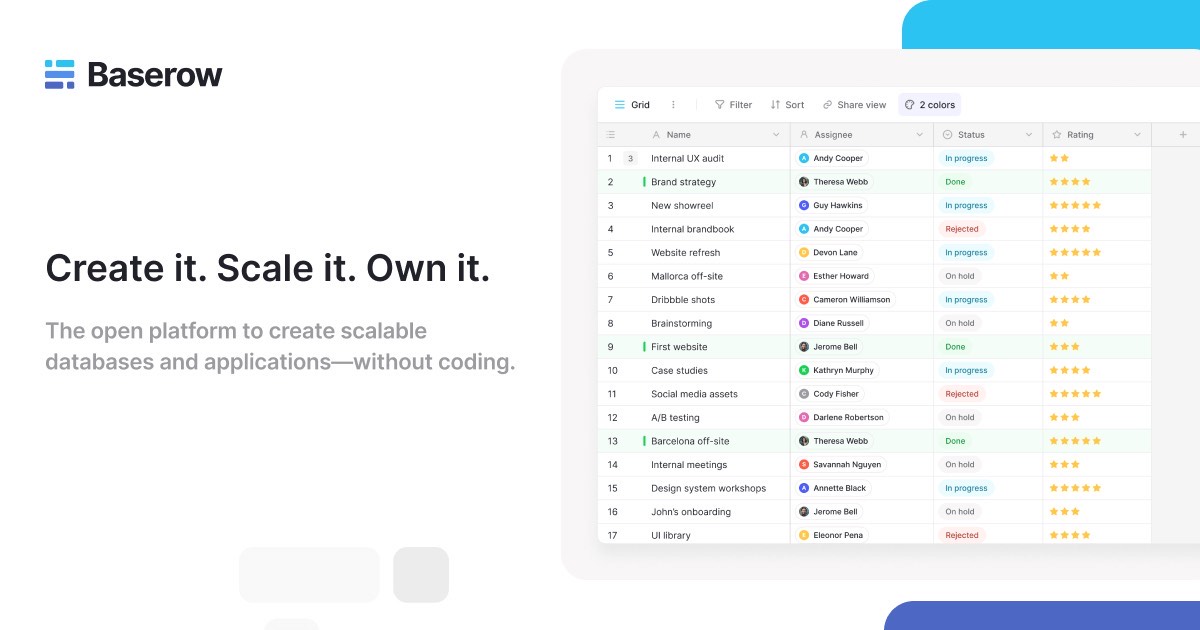
Baserow is the most Airtable-like open-source option. Its core is open source, and the self-hosted version has no row limits. Advanced features such as some views and role-based permissions require a paid license.
Pricing: cloud Free includes 3,000 rows and 2 GB of storage per workspace. Premium costs $10 per user per month billed annually ($12 monthly) with 50,000 rows. Advanced costs $18 ($22 monthly) with 250,000 rows.
- Pros: open-source core; no row limits when self-hosted; the largest free row allowance among the database tools in this list (3,000 rows, versus 1,000 for Airtable and NocoDB).
- Cons: some advanced features are paid even when self-hosted; a smaller ecosystem of integrations than Airtable.
Choose it if: you want an Airtable-style interface you fully control.
6.  Notion — best for docs plus light databases
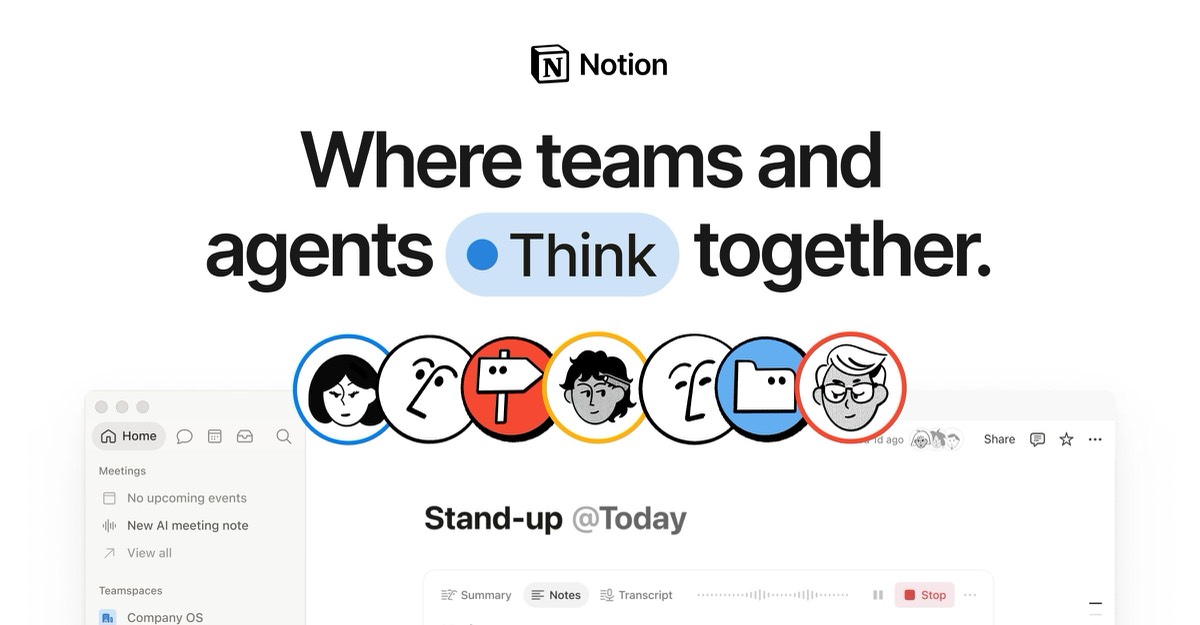
Many teams use Airtable for things that are really documentation: wikis, content plans, meeting notes with a status column. Notion handles that better, with databases embedded directly in pages.
Pricing: free for individuals; block storage is limited for workspaces with 2 or more members. Plus costs $10 and Business $20 per seat per month (monthly price; yearly billing saves up to 20%).
- Pros: best writing and documentation experience; databases live inside pages; huge template library.
- Cons: automations are basic on lower plans; not designed for large datasets or complex relational structures.
Choose it if: your team writes more than it tracks.
How to choose the right Airtable alternative
- Count your records. Under 5,000? Almost any tool works. Above 50,000? Look at SmartSuite Professional, NocoDB Business, Baserow Advanced, or self-hosting.
- Count your editors, not your users. Per-seat pricing is the biggest cost driver. NocoDB's unlimited-seat plan and self-hosted options flatten it.
- List your automations. Check monthly caps against your current Airtable usage before you migrate.
- Decide on hosting. If data ownership matters, only NocoDB and Baserow can run on your own server.
- Test with your real base. Export a copy of your Airtable base as CSV and import it during the free trial.
FAQ
Is there a free alternative to Airtable?
Yes. Baserow's free cloud plan includes 3,000 rows per workspace, ClickUp and monday.com have free plans for small teams, and NocoDB and Baserow can be self-hosted for free with no row limits.
What is the best open-source Airtable alternative?
Baserow and NocoDB are the two main options. Baserow feels closest to Airtable's interface; NocoDB is popular for its API and automation use cases. Both can run on a small VPS.
Can I self-host an Airtable alternative?
Yes. NocoDB's Community edition and Baserow's open-source edition both run on your own server, typically with Docker. You are then responsible for updates and backups.
Is there a Microsoft alternative to Airtable?
Microsoft Lists, included in most Microsoft 365 business plans, covers basic list and tracking use cases. It is less flexible than Airtable for linked records and formulas.
Which Airtable alternative has the highest record limit?
Among cloud plans, NocoDB Scale and Baserow Enterprise go up to 1,000,000 records, and SmartSuite Enterprise to 400,000 records per solution. Self-hosted NocoDB and Baserow have no record limit.
How we compared these tools
Prices and plan limits were checked on each vendor's official pricing page on October 29, 2026. Vendors change pricing often; tell us if something is out of date.